


Raumbeispiel
137
Alexej von Jawlensky
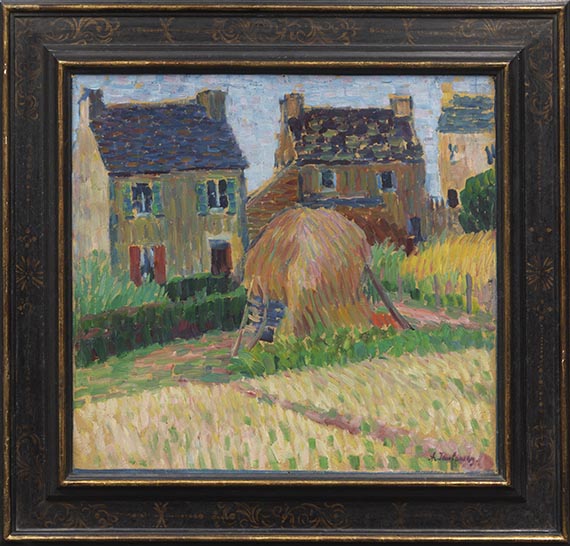
Bretonische Häuser mit Heuhaufen, Um 1906.
Oil on cardboard
Estimation:
€ 100,000 / $ 116,000 Résultat:
€ 251,550 / $ 291,798 ( frais d'adjudication compris)
137
Alexej von Jawlensky
Bretonische Häuser mit Heuhaufen, Um 1906.
Oil on cardboard
Estimation:
€ 100,000 / $ 116,000 Résultat:
€ 251,550 / $ 291,798 ( frais d'adjudication compris)
Alexej von Jawlensky
1864 - 1941
Bretonische Häuser mit Heuhaufen. Around 1906.
Oil on cardboard.
Signed in the lower right. 49.7 x 53 cm (19.5 x 20.8 in).
[AR].
• One of the rare early French landscapes that captivates with its loose, pointillist brushwork.
• Liberated color: Jawlensky stated that it was in Brittany that he first succeeded in expressing his feelings through painting.
• Exhibited in the artist’s first major Spanish retrospective at the Fundación Juan March, Madrid (1992).
• Other works created in Carantec are located today in the Pinakothek der Moderne, Munich (“Coast near Carantec” and “Landscape from Carantec with Woman”) as well as in the Albertina, Vienna (“Cornfield near Carantec”).
We are grateful to Roman Zieglgänsberger, Museum Wiesbaden, for his kind expert advice.
PROVENANCE: Private collection, Munich (with a label on the reverse).
Private collection, Southern Germany.
Family-owned ever since.
EXHIBITION: Alexej von Jawlensky, Fundación Juan March, Madrid, March 27–June 14, 1992; Museo Picasso, Barcelona, June 25–September 27, 1992, cat. no. 14 (illustrated in color on p. 41; label on the back of the frame).
Alexej von Jawlensky: Magical Images, Kunsthalle Krems, April 27–September 21, 2003, no catalog number (illustrated in color on p. 52).
Alexej von Jawlensky, Galerie Thomas, Munich, Nov. 6, 2015–Feb. 13, 2016, no catalog number, pp. 15 and 103 (each illustrated in color).
LITERATURE: Maria Jawlensky, Lucia Pieroni-Jawlensky, Angelica Jawlensky, Alexej von Jawlensky. Catalogue Raisonné of the Oil Paintings, vol. 1: 1890–1914, Munich 1991, CR no. 105 (illustrated in black and white).
- -
Neumeister, Munich, Neumeister’s Modern Art, Auction 7, May 26, 1990, Lot 244 (illustrated in color, plate 21).
“For the first time, I realized then that I was painting not what I saw, but what I felt (..) And I understood how to translate nature into colors in keeping with my passionate soul.”
Alexej von Jawlensky, quoted from: Alexej von Jawlensky, Reisen, Freunde, Wandlungen, exhibition catalog Dortmund 1998, p. 42.
1864 - 1941
Bretonische Häuser mit Heuhaufen. Around 1906.
Oil on cardboard.
Signed in the lower right. 49.7 x 53 cm (19.5 x 20.8 in).
[AR].
• One of the rare early French landscapes that captivates with its loose, pointillist brushwork.
• Liberated color: Jawlensky stated that it was in Brittany that he first succeeded in expressing his feelings through painting.
• Exhibited in the artist’s first major Spanish retrospective at the Fundación Juan March, Madrid (1992).
• Other works created in Carantec are located today in the Pinakothek der Moderne, Munich (“Coast near Carantec” and “Landscape from Carantec with Woman”) as well as in the Albertina, Vienna (“Cornfield near Carantec”).
We are grateful to Roman Zieglgänsberger, Museum Wiesbaden, for his kind expert advice.
PROVENANCE: Private collection, Munich (with a label on the reverse).
Private collection, Southern Germany.
Family-owned ever since.
EXHIBITION: Alexej von Jawlensky, Fundación Juan March, Madrid, March 27–June 14, 1992; Museo Picasso, Barcelona, June 25–September 27, 1992, cat. no. 14 (illustrated in color on p. 41; label on the back of the frame).
Alexej von Jawlensky: Magical Images, Kunsthalle Krems, April 27–September 21, 2003, no catalog number (illustrated in color on p. 52).
Alexej von Jawlensky, Galerie Thomas, Munich, Nov. 6, 2015–Feb. 13, 2016, no catalog number, pp. 15 and 103 (each illustrated in color).
LITERATURE: Maria Jawlensky, Lucia Pieroni-Jawlensky, Angelica Jawlensky, Alexej von Jawlensky. Catalogue Raisonné of the Oil Paintings, vol. 1: 1890–1914, Munich 1991, CR no. 105 (illustrated in black and white).
- -
Neumeister, Munich, Neumeister’s Modern Art, Auction 7, May 26, 1990, Lot 244 (illustrated in color, plate 21).
“For the first time, I realized then that I was painting not what I saw, but what I felt (..) And I understood how to translate nature into colors in keeping with my passionate soul.”
Alexej von Jawlensky, quoted from: Alexej von Jawlensky, Reisen, Freunde, Wandlungen, exhibition catalog Dortmund 1998, p. 42.
Alexej von Jawlensky, who had been living in Munich with Marianne von Werefkin since 1896, began exploring his unique artistic style around the turn of the century. He traveled throughout Europe, visited exhibitions, and engaged with the latest trends in French painting. In particular, the works of Vincent van Gogh and Paul Gauguin, as well as those of the “Fauves”, influenced his development and led to a noticeable change in his palette and artistic vision.
He visited France for the first time as early as 1903, but it was not until a few years later, in 1905–06, that he visited Carantec in Brittany; however, Jawlensky’s letters provide only evidence of a stay in this Breton village northwest of Brest in 1906. The landscape there became a place of artistic revelation for Jawlensky. As he later described himself, it was here that he began to paint not what he saw, but what he felt.
This painting, too, was created in this setting and bears witness to his emerging artistic transformation. Set against a backdrop of fields and sky, he brings together the typical Breton stone buildings—adorned with colorful shutters—and a haystack reminiscent of Claude Monet into a vibrant whole, dissolving forms into vibrant areas that unfold dynamically across the canvas. He experimented with short, fluid brushstrokes and enhanced color intensity, which increasingly became the vehicle for his emotion.
His interest lies less in individual motifs than in the interplay of light and color, which manifests itself in the dynamic landscape with architecture, fields, plants, and sky. It is an intense testament to Jawlensky’s artistic awakening and his search for a deeply personal visual language. [AR]
He visited France for the first time as early as 1903, but it was not until a few years later, in 1905–06, that he visited Carantec in Brittany; however, Jawlensky’s letters provide only evidence of a stay in this Breton village northwest of Brest in 1906. The landscape there became a place of artistic revelation for Jawlensky. As he later described himself, it was here that he began to paint not what he saw, but what he felt.
This painting, too, was created in this setting and bears witness to his emerging artistic transformation. Set against a backdrop of fields and sky, he brings together the typical Breton stone buildings—adorned with colorful shutters—and a haystack reminiscent of Claude Monet into a vibrant whole, dissolving forms into vibrant areas that unfold dynamically across the canvas. He experimented with short, fluid brushstrokes and enhanced color intensity, which increasingly became the vehicle for his emotion.
His interest lies less in individual motifs than in the interplay of light and color, which manifests itself in the dynamic landscape with architecture, fields, plants, and sky. It is an intense testament to Jawlensky’s artistic awakening and his search for a deeply personal visual language. [AR]