


Image du cadre
203
Cy Twombly
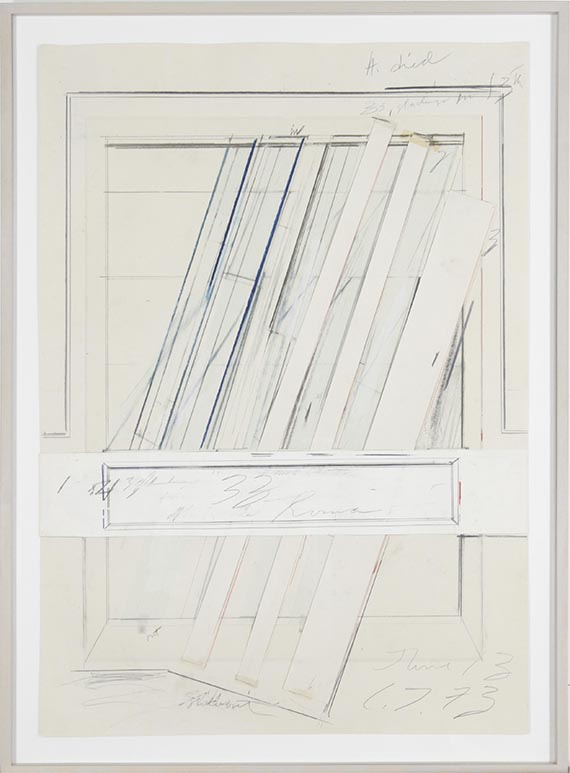
Gladings (Love’s Infinite Causes), 1973.
Collage. Colored oil pastels, pencil, and colla...
Estimation:
€ 100,000 / $ 116,000 Résultat:
€ 129,000 / $ 149,640 ( frais d'adjudication compris)
203
Cy Twombly
Gladings (Love’s Infinite Causes), 1973.
Collage. Colored oil pastels, pencil, and colla...
Estimation:
€ 100,000 / $ 116,000 Résultat:
€ 129,000 / $ 149,640 ( frais d'adjudication compris)
Cy Twombly
1928 - 2011
Gladings (Love’s Infinite Causes). 1973.
Collage. Colored oil pastels, pencil, and collaged paper over offset lithography.
Monogrammed and dated “June 1913 / C.T. 73” in the lower right corner and inscribed “33 Roma” in the center of the image. 100 x 69.9 cm (39.3 x 27.5 in), the full sheet.
Twombly uses unnumbered proofs of his graphic work Untitled (1973) as the basis for the series Gladings (Love's Infinite Causes), cf. Heiner Bastian, Cy Twombly. A Catalogue Raisonné of The Printed Graphic Work, Munich/New York 1984, CR numbers 39 and 40. [JS].
• Poetic condensation and enigmatic imagery: Masterful transformation of existential feelings into a symbolic, condensed imagery.
• Love/Rome/Antiquity/Poetry: Mysterious intertwining of biographical, historical, poetic, and philosophical references.
• Gladings (Love's Infinite Causes): Rare combination of drawing and collage.
• Since 1990, only three other works from the 12-part series have been offered on the international auction market.
PROVENANCE: Galleria Gian Enzo Sperone, Turin.
Galerie Art in Progress, Munich (with the label on the reverse of the frame).
Private collection, Southern Germany (acquired from the above in 1974).
LITERATURE: Nicola del Roscio, Cy Twombly. Drawings, Catalogue Raisonné, vol. 6 1972-1979, New York 2016, CR no. 43 (illustrated on p. 52).
Yvon Lambert, Cy Twombly. Catalogue raisonné des oeuvres sur papier, vol. VI, 1973-1976, Milan 1979, CR no. 12 (illustrated on p. 36).
1928 - 2011
Gladings (Love’s Infinite Causes). 1973.
Collage. Colored oil pastels, pencil, and collaged paper over offset lithography.
Monogrammed and dated “June 1913 / C.T. 73” in the lower right corner and inscribed “33 Roma” in the center of the image. 100 x 69.9 cm (39.3 x 27.5 in), the full sheet.
Twombly uses unnumbered proofs of his graphic work Untitled (1973) as the basis for the series Gladings (Love's Infinite Causes), cf. Heiner Bastian, Cy Twombly. A Catalogue Raisonné of The Printed Graphic Work, Munich/New York 1984, CR numbers 39 and 40. [JS].
• Poetic condensation and enigmatic imagery: Masterful transformation of existential feelings into a symbolic, condensed imagery.
• Love/Rome/Antiquity/Poetry: Mysterious intertwining of biographical, historical, poetic, and philosophical references.
• Gladings (Love's Infinite Causes): Rare combination of drawing and collage.
• Since 1990, only three other works from the 12-part series have been offered on the international auction market.
PROVENANCE: Galleria Gian Enzo Sperone, Turin.
Galerie Art in Progress, Munich (with the label on the reverse of the frame).
Private collection, Southern Germany (acquired from the above in 1974).
LITERATURE: Nicola del Roscio, Cy Twombly. Drawings, Catalogue Raisonné, vol. 6 1972-1979, New York 2016, CR no. 43 (illustrated on p. 52).
Yvon Lambert, Cy Twombly. Catalogue raisonné des oeuvres sur papier, vol. VI, 1973-1976, Milan 1979, CR no. 12 (illustrated on p. 36).
Cy Twombly is a master of lyrical abstraction. Building on his early artistic collaboration with his fellow student Robert Rauschenberg in New York during the 1950s—the heyday of Abstract Expressionism—Twombly developed an enigmatic style characterized by overlapping symbols and pictorial abbreviations in the years that followed. In 1973, the year this intriguing composition “Gladings (Love’s Infinite Causes),” was created—featuring, among other elements, the spontaneously written line “33 Roma” at its center—Twombly had already been living in Rome and elsewhere in Italy for more than a decade. Whether the number is to be understood as a direct reference to Twombly’s first Roman address at Via di Monserrato 33—and thus to the impressive 17th-century palazzo where Twombly, newly married in the late 1950s, moved in with his aristocratic wife Tatiana Franchetti—must remain open to interpretation. And yet, in terms of content, it would fit seamlessly into a work subtitled “The Infinite Causes of Love”: “Love’s Infinite Causes” is the line—still faintly legible—that Twombly added to the central designation “33 Roma” . These impressive living and working spaces became one of the world’s most famous and fascinating artist studios in 1966 after a photo featured in Vogue magazine. The work of the intellectual Twombly, an Italian by choice, which appears impressively spontaneous yet always rich in content and poetic density, was not only heavily influenced by the the Italian mentality and its rich cultural history, but also by the Romantic and Symbolist poetry that drew upon antiquity. Due to its distinctive linguistic density and imagery, this poetry exerted an enormous attraction on the American artist. In addition to Friedrich Hölderlin’s hymns, it was, above all the symbolist works of the French poet Stéphane Mallarmé—and thus 19th-century poetry—that played a decisive role in the evolution of Twombly’s metaphorical and poetic style, characterized by layers upon layers of imagery. Can we read “H. Lied” in the upper right corner, perhaps a cryptic reference to Hölderlin’s poem “Hyperion’s Song of Destiny,” which includes the lines: “Yet it is given to us,/ to rest in no place,/ to fade, to fall,/ the suffering people/ blindly from one/ hour to the next,/ Like water cast from cliff/ To cliff, / Year after year down into the unknown.” Does “Gladings (Love’s Infinite Causes)” also embody Twombly’s fascination with the imagery of the infinite sound of the sea? First explored by Twombly in the 1959 series of drawings “Poems to the Sea” and other works created in Anacapri. The watery-blue tones and the complete devotion to the line are what Twombly uses to translate the ceaseless rolling of the waves into an intoxicating artistic language. Just like the wave, every line exists in the artistic sensibility only in the here and now, for, as Twombly explains, “each line is now the actual experience with its own innate history. It does not illustrate—it is the sensation of its own realization” (C. Twombly, 2000, quoted from: Claire Daigle, Lingering at The Threshold, in: Tate etc., Vol. 13, Summer 2008). [JS]