


Video
Image du cadre
Raumbeispiel
118
Lyonel Feininger
Figuren in Rot, Blau, Weiß und Gelb, Ca. 1955/56.
Oil on burlap
Estimation: € 100,000 / $ 117,000
118
Lyonel Feininger
Figuren in Rot, Blau, Weiß und Gelb, Ca. 1955/56.
Oil on burlap
Estimation: € 100,000 / $ 117,000
Lyonel Feininger
1871 - 1956
Figuren in Rot, Blau, Weiß und Gelb. Ca. 1955/56.
Oil on burlap.
38 x 61 cm (14.9 x 24 in).
The work is mentioned as an “unfinished work” in the addendum to Hans Hess’s publication Lyonel Feininger, New York 1961. [AR].
• From the estate of Feininger's son, T. Lux Feininger.
• This is the first time it is offered on the international auction market.
• Rarity: the only known painting with the motif of the small figures, also called “ghosties” or “Männekens.”
• Feininger's witty creatures are usually only known from watercolors and drawings, which the artist mostly made as personal gifts and on greeting cards.
• Elusiveness, humor, and character: a remarkable stylistic reference to Feininger's early days as a caricaturist.
Achim Moeller, Director of the Lyonel Feininger Project, New York–Berlin, has confirmed the authenticity of this work, which is registered in the Lyonel Feininger Project archive under number 2023-10-08-25. The painting is listed in Lyonel Feininger: The Catalogue Raisonné of Paintings by Achim Moeller under number 569. The work is accompanied by a certificate.
Additional information was provided by Achim Moeller, The Lyonel Feininger Project, New York – Berlin.
PROVENANCE: Estate of the artist, New York.
Theodore Lux (T. Lux) Feininger, Cambridge, MA (inherited).
Estate of T. Lux Feininger, Cambridge, MA (inherited).
Private collection, southern Germany.
EXHIBITION: An Exhibition of Works by Lyonel Feininger, T. Lux Feininger, Andreas Feininger, Laurence Feininger, Widener Gallery, Austin Arts Center, Trinity College, Hartford, Oct. 1-30, 1967, cat. no. 7 (mentioned as "Untitled [Spooky Figures]" and dated 1956).
Lyonel Feininger: Retrospective in Japan, Yokosuka Museum of Art, Yokosuka, Aug. 2-Oct. 5, 2008, Aichi Prefectural Museum of Art, Higashisakura, Oct. 17-Dec. 23, 2008, Miyagi Museum of Art, Sendai, Jan. 10-March 1, 2009, cat. no. 133, p. 197 (mentioned as "Untitled (Figures in Red, Blue, White and Yellow)" and dated ca. 1953, illustrated in color on p. 158, with an exhib. label on the reverse).
Lyonel Feininger. Zurück in Amerika. 1937-1956, Foundation Moritzburg, Kunstmuseum des Landes Sachsen-Anhalt, Halle (Saale), May 16-Aug. 23, 2009, cat. no. 35, p. 222 (illusztrated in color on p. 197, mentioned as "Ohne Titel (Figuren in Rot, Blau, Weiß und Gelb)" and dated 1953).
LITERATURE: Achim Moeller, “(Figures in Red, Blue, White, and Yellow), c. 1955–1956 (Moeller 569),” in: Lyonel Feininger: The Catalogue Raisonné of Paintings, http://feiningerproject.org/ (accessed October 8, 2025).
Hans Hess, Lyonel Feininger, New York 1961, No. C, p. 300 (listed here in the addendum of the “unfinished works”).
- -
Sebastian Ehlert, “From Papileo, with Love,” in: Moeller Fine Art (ed.), The Enchanted World of Lyonel Feininger, exhibition catalog, New York 2019, pp. 75-79, here p. 77 (with color ill. no. 5, p. 79, mentioned as “(Spooky Figures)” and dated to approx. 1950-1955).
"The prankish but benign goblins do not seem to be fully corporealized; they give the impression that they will disappear before one's eyes before they have ever fully existed. "
Ernst Scheyer, Lyonel Feininger - caricature & fantasy, Detroit 1964, p. 148.
Called up: June 13, 2026 - ca. 13.24 h +/- 20 min.
1871 - 1956
Figuren in Rot, Blau, Weiß und Gelb. Ca. 1955/56.
Oil on burlap.
38 x 61 cm (14.9 x 24 in).
The work is mentioned as an “unfinished work” in the addendum to Hans Hess’s publication Lyonel Feininger, New York 1961. [AR].
• From the estate of Feininger's son, T. Lux Feininger.
• This is the first time it is offered on the international auction market.
• Rarity: the only known painting with the motif of the small figures, also called “ghosties” or “Männekens.”
• Feininger's witty creatures are usually only known from watercolors and drawings, which the artist mostly made as personal gifts and on greeting cards.
• Elusiveness, humor, and character: a remarkable stylistic reference to Feininger's early days as a caricaturist.
Achim Moeller, Director of the Lyonel Feininger Project, New York–Berlin, has confirmed the authenticity of this work, which is registered in the Lyonel Feininger Project archive under number 2023-10-08-25. The painting is listed in Lyonel Feininger: The Catalogue Raisonné of Paintings by Achim Moeller under number 569. The work is accompanied by a certificate.
Additional information was provided by Achim Moeller, The Lyonel Feininger Project, New York – Berlin.
PROVENANCE: Estate of the artist, New York.
Theodore Lux (T. Lux) Feininger, Cambridge, MA (inherited).
Estate of T. Lux Feininger, Cambridge, MA (inherited).
Private collection, southern Germany.
EXHIBITION: An Exhibition of Works by Lyonel Feininger, T. Lux Feininger, Andreas Feininger, Laurence Feininger, Widener Gallery, Austin Arts Center, Trinity College, Hartford, Oct. 1-30, 1967, cat. no. 7 (mentioned as "Untitled [Spooky Figures]" and dated 1956).
Lyonel Feininger: Retrospective in Japan, Yokosuka Museum of Art, Yokosuka, Aug. 2-Oct. 5, 2008, Aichi Prefectural Museum of Art, Higashisakura, Oct. 17-Dec. 23, 2008, Miyagi Museum of Art, Sendai, Jan. 10-March 1, 2009, cat. no. 133, p. 197 (mentioned as "Untitled (Figures in Red, Blue, White and Yellow)" and dated ca. 1953, illustrated in color on p. 158, with an exhib. label on the reverse).
Lyonel Feininger. Zurück in Amerika. 1937-1956, Foundation Moritzburg, Kunstmuseum des Landes Sachsen-Anhalt, Halle (Saale), May 16-Aug. 23, 2009, cat. no. 35, p. 222 (illusztrated in color on p. 197, mentioned as "Ohne Titel (Figuren in Rot, Blau, Weiß und Gelb)" and dated 1953).
LITERATURE: Achim Moeller, “(Figures in Red, Blue, White, and Yellow), c. 1955–1956 (Moeller 569),” in: Lyonel Feininger: The Catalogue Raisonné of Paintings, http://feiningerproject.org/ (accessed October 8, 2025).
Hans Hess, Lyonel Feininger, New York 1961, No. C, p. 300 (listed here in the addendum of the “unfinished works”).
- -
Sebastian Ehlert, “From Papileo, with Love,” in: Moeller Fine Art (ed.), The Enchanted World of Lyonel Feininger, exhibition catalog, New York 2019, pp. 75-79, here p. 77 (with color ill. no. 5, p. 79, mentioned as “(Spooky Figures)” and dated to approx. 1950-1955).
"The prankish but benign goblins do not seem to be fully corporealized; they give the impression that they will disappear before one's eyes before they have ever fully existed. "
Ernst Scheyer, Lyonel Feininger - caricature & fantasy, Detroit 1964, p. 148.
Called up: June 13, 2026 - ca. 13.24 h +/- 20 min.
Some time after his return to the United States, Lyonel Feininger began working on a new series of motifs known as the “Ghosties” or “Männekens.” These are among the most intimate and personal works in his oeuvre and consist almost exclusively of watercolors and drawings, created from the late 1940s until the artist died in 1956. Most were used as private gifts or on greeting cards for family and friends, and depict small figures, fleeting characters with highly distinctive expressions and personalities, drawn with humorous, exaggerated features.
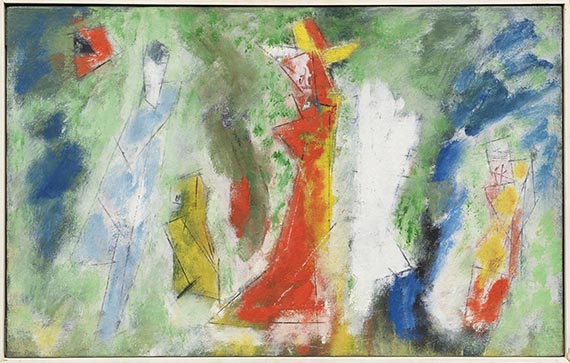
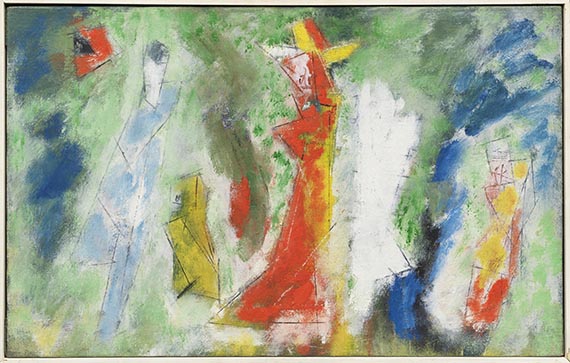
The work “Figures in Red, Blue, White, and Yellow” from 1955/56, from the estate of T. Lux Feininger, one of the artist’s sons, is the only known painting in this series in which the “Ghosties” act as the sole protagonists. Feininger allows a small group of figures to emerge from a mist of light green, with some of the beings suggested only as shadowy clouds of color, while others have been divided into geometric fields by dark lines. Their contours appear as if wrapped in long coats; some wear hats, and a few have almost human faces with eyes and noses. Although the figures do not interact with one another, they nevertheless seem to be involved in a shared narrative that follows the imaginary rules of their small, colorful world. They appear like little rogues or a conspiratorial gathering of friends who, wrapped in their colorful cloaks, hide from prying eyes within the mist of color. Or as Ernst Scheyer once so aptly described it: “The prankish but benign goblins do not seem to be fully corporealized; they give the impression that they will disappear before one’s eyes before they have ever fully existed.” (Ernst Scheyer, Lyonel Feininger - caricature & fantasy, Detroit 1964, p. 148)
In addition to the imaginative, narrative quality that is always inherent in Lyonel Feininger’s depictions of ghosts, the painting “Figures in Red, Blue, White, and Yellow” also holds special stylistic significance, as it combines the characteristic features of his late work with a remarkable stylistic reference to Feininger’s early days as a caricaturist. The style he developed only late in life in America—with its typical, almost abstract dissolution of the motif into cloudy mists of color, sometimes imbued with a lyrical-mystical aura—enters here into a brilliant dialogue with the wit of his caricatures. Almost as incidentally, the small painting offers a glimpse into the subtle humor of the creator of these small, endearing figures—a sense of humor that Lyonel Feininger retained until the end of his life. [AR]
The work “Figures in Red, Blue, White, and Yellow” from 1955/56, from the estate of T. Lux Feininger, one of the artist’s sons, is the only known painting in this series in which the “Ghosties” act as the sole protagonists. Feininger allows a small group of figures to emerge from a mist of light green, with some of the beings suggested only as shadowy clouds of color, while others have been divided into geometric fields by dark lines. Their contours appear as if wrapped in long coats; some wear hats, and a few have almost human faces with eyes and noses. Although the figures do not interact with one another, they nevertheless seem to be involved in a shared narrative that follows the imaginary rules of their small, colorful world. They appear like little rogues or a conspiratorial gathering of friends who, wrapped in their colorful cloaks, hide from prying eyes within the mist of color. Or as Ernst Scheyer once so aptly described it: “The prankish but benign goblins do not seem to be fully corporealized; they give the impression that they will disappear before one’s eyes before they have ever fully existed.” (Ernst Scheyer, Lyonel Feininger - caricature & fantasy, Detroit 1964, p. 148)
In addition to the imaginative, narrative quality that is always inherent in Lyonel Feininger’s depictions of ghosts, the painting “Figures in Red, Blue, White, and Yellow” also holds special stylistic significance, as it combines the characteristic features of his late work with a remarkable stylistic reference to Feininger’s early days as a caricaturist. The style he developed only late in life in America—with its typical, almost abstract dissolution of the motif into cloudy mists of color, sometimes imbued with a lyrical-mystical aura—enters here into a brilliant dialogue with the wit of his caricatures. Almost as incidentally, the small painting offers a glimpse into the subtle humor of the creator of these small, endearing figures—a sense of humor that Lyonel Feininger retained until the end of his life. [AR]
Commission, taxes et droit de suite
Cet objet est offert avec imposition régulière.
Calcul en cas d'imposition régulière:
Prix d’adjudication jusqu’à 1 000 000 euros : frais de vente 29%.
Des frais de vente de 23% sont facturés sur la partie du prix d’adjudication dépassant 1 000 000 euros. Ils sont additionnés aux frais de vente dus pour la partie du prix d’adjudication allant jusqu’à 1 000 000 euros.
Des frais de vente de 15 % sont facturés sur la partie du prix d’adjudication dépassant 4 000 000 euros. Ils sont additionnés aux frais de vente dus pour la partie du prix d’adjudication allant jusqu’à 4 000 000 euros.
La taxe sur la valeur ajoutée allemande, actuellement de 7 %, est perçue sur la somme du prix d’adjudication et des frais de vente.
Pour les entreprises habilitées à déduire la TVA, le régime fiscal général peut être appliqué.
Calcul en cas de droit de suite:
Pour les œuvres originales d’arts plastiques et de photographie d’artistes vivants ou d’artistes décédés il y a moins de 70 ans, soumises au droit de suite, une rémunération au titre du droit de suite à hauteur des pourcentages indiqués au § 26, al. 2 de la loi allemande sur les droits d’auteur (UrhG) est facturée en sus pour compenser la rémunération liée au droit de suite due par le commissaire-priseur conformément au § 26 UrhG. À ce jour, elle est calculée comme suit :
4 pour cent pour la part du produit de la vente à partir de 400,00 euros et jusqu’à 50 000 euros,
3 pour cent supplémentaires pour la part du produit de la vente entre 50 000,01 et 200 000 euros,
1 pour cent supplémentaire pour la part entre 200 000,01 et 350 000 euros,
0,5 pour cent supplémentaire pour la part entre 350 000,01 et 500 000 euros et
0,25 pour cent supplémentaire pour la part au-delà de 500 000 euros.
Le total de la rémunération au titre du droit de suite pour une revente s’élève au maximum à 12 500 euros.
Calcul en cas d'imposition régulière:
Prix d’adjudication jusqu’à 1 000 000 euros : frais de vente 29%.
Des frais de vente de 23% sont facturés sur la partie du prix d’adjudication dépassant 1 000 000 euros. Ils sont additionnés aux frais de vente dus pour la partie du prix d’adjudication allant jusqu’à 1 000 000 euros.
Des frais de vente de 15 % sont facturés sur la partie du prix d’adjudication dépassant 4 000 000 euros. Ils sont additionnés aux frais de vente dus pour la partie du prix d’adjudication allant jusqu’à 4 000 000 euros.
La taxe sur la valeur ajoutée allemande, actuellement de 7 %, est perçue sur la somme du prix d’adjudication et des frais de vente.
Pour les entreprises habilitées à déduire la TVA, le régime fiscal général peut être appliqué.
Calcul en cas de droit de suite:
Pour les œuvres originales d’arts plastiques et de photographie d’artistes vivants ou d’artistes décédés il y a moins de 70 ans, soumises au droit de suite, une rémunération au titre du droit de suite à hauteur des pourcentages indiqués au § 26, al. 2 de la loi allemande sur les droits d’auteur (UrhG) est facturée en sus pour compenser la rémunération liée au droit de suite due par le commissaire-priseur conformément au § 26 UrhG. À ce jour, elle est calculée comme suit :
4 pour cent pour la part du produit de la vente à partir de 400,00 euros et jusqu’à 50 000 euros,
3 pour cent supplémentaires pour la part du produit de la vente entre 50 000,01 et 200 000 euros,
1 pour cent supplémentaire pour la part entre 200 000,01 et 350 000 euros,
0,5 pour cent supplémentaire pour la part entre 350 000,01 et 500 000 euros et
0,25 pour cent supplémentaire pour la part au-delà de 500 000 euros.
Le total de la rémunération au titre du droit de suite pour une revente s’élève au maximum à 12 500 euros.