


Image du cadre
215
Ernst Ludwig Kirchner
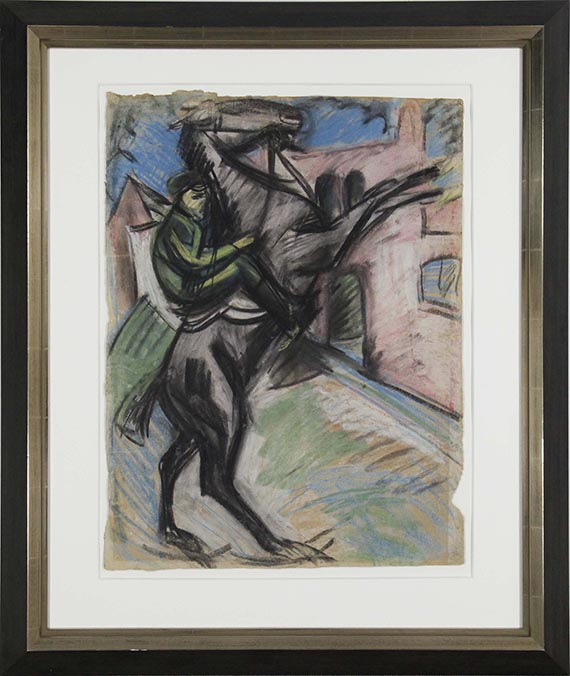
Reiter auf scheuendem Pferd vor roten Häusern, Ca. 1915.
Pastel and color chalks
Estimation: € 90,000 / $ 105,300
215
Ernst Ludwig Kirchner
Reiter auf scheuendem Pferd vor roten Häusern, Ca. 1915.
Pastel and color chalks
Estimation: € 90,000 / $ 105,300
Ernst Ludwig Kirchner
1880 - 1938
Reiter auf scheuendem Pferd vor roten Häusern. Ca. 1915.
Pastel and color chalks.
With the estate stamp of the Kunstmuseum Basel (Lugt 1570 b) and the handwritten registration number “FS Be / Bl 1” on the reverse. On off-white laid paper (with the watermark “SLG”). 66.5 x 51.2 cm (26.1 x 20.1 in), the full sheet.
With an additional full-page, partially colored drawing of a rider on a rearing horse on tzhe reverse. It is documented in several historical photographs by E. L. Kirchner (see Roland Scotti (ed.), Ernst Ludwig Kirchner. Das fotografische Werk, Bern 2005, cat. nos. 41, 241, 242, 332). [CH].
• A dynamic, lively drawing from the artist’s sought-after Berlin creative years.
• Rarity: color drawings of this size are extremely rare on the international auction market.
• Painted on both sides: with another full-sheet drawing documented on E. L. Kirchner’s photographs on the reverse.
• Upheaval and change: World War I marked a radical turning point in Kirchner’s life and work.
• Kirchner explored the motif of a rider on a rearing horse in several drawings, photographs, a print, a painting, and a wood sculpture around 1915.
• Part of the same private collection since 1979.
The work is documented in the Ernst Ludwig Kirchner Archive, Wichtrach/Bern.
PROVENANCE: From the artist’s estate, Davos (1938).
Erna Schilling (1884–1945), Davos (the artist’s partner, until 1945).
Kunstmuseum Basel (on deposit with the remainder of the artist’s estate, 1946–1954).
Stuttgarter Kunstkabinett Roman Norbert Ketterer, Stuttgart (1958).
Galeria Henze, Campione d’Italia (until 1978).
Galerie Utermann, Dortmund.
Private collection (acquired from the above in 1979).
LITERATURE: Stuttgarter Kunstkabinett Roman Norbert Ketterer, Stuttgart, 32nd Auction, Modern Art, 1958, lot 418 (illustrated, plate 59).
Galeria Henze, Catalog 14, Campione d'Italia 1977, cat. no. 75 (illustrated).
Galeria Henze, Catalog 18, Campione d'Italia 1978, cat. no. 80 (illustrated).
Called up: June 13, 2026 - ca. 15.33 h +/- 20 min.
1880 - 1938
Reiter auf scheuendem Pferd vor roten Häusern. Ca. 1915.
Pastel and color chalks.
With the estate stamp of the Kunstmuseum Basel (Lugt 1570 b) and the handwritten registration number “FS Be / Bl 1” on the reverse. On off-white laid paper (with the watermark “SLG”). 66.5 x 51.2 cm (26.1 x 20.1 in), the full sheet.
With an additional full-page, partially colored drawing of a rider on a rearing horse on tzhe reverse. It is documented in several historical photographs by E. L. Kirchner (see Roland Scotti (ed.), Ernst Ludwig Kirchner. Das fotografische Werk, Bern 2005, cat. nos. 41, 241, 242, 332). [CH].
• A dynamic, lively drawing from the artist’s sought-after Berlin creative years.
• Rarity: color drawings of this size are extremely rare on the international auction market.
• Painted on both sides: with another full-sheet drawing documented on E. L. Kirchner’s photographs on the reverse.
• Upheaval and change: World War I marked a radical turning point in Kirchner’s life and work.
• Kirchner explored the motif of a rider on a rearing horse in several drawings, photographs, a print, a painting, and a wood sculpture around 1915.
• Part of the same private collection since 1979.
The work is documented in the Ernst Ludwig Kirchner Archive, Wichtrach/Bern.
PROVENANCE: From the artist’s estate, Davos (1938).
Erna Schilling (1884–1945), Davos (the artist’s partner, until 1945).
Kunstmuseum Basel (on deposit with the remainder of the artist’s estate, 1946–1954).
Stuttgarter Kunstkabinett Roman Norbert Ketterer, Stuttgart (1958).
Galeria Henze, Campione d’Italia (until 1978).
Galerie Utermann, Dortmund.
Private collection (acquired from the above in 1979).
LITERATURE: Stuttgarter Kunstkabinett Roman Norbert Ketterer, Stuttgart, 32nd Auction, Modern Art, 1958, lot 418 (illustrated, plate 59).
Galeria Henze, Catalog 14, Campione d'Italia 1977, cat. no. 75 (illustrated).
Galeria Henze, Catalog 18, Campione d'Italia 1978, cat. no. 80 (illustrated).
Called up: June 13, 2026 - ca. 15.33 h +/- 20 min.
After the outbreak of war in 1915, Kirchner volunteered for military service and served with the 75th Mansfeld Mounted Field Artillery Regiment in Halle an der Saale. The artist soon wrote a desperate letter to his patron Karl Ernst Osthaus: “It is so terrible; one is merely tolerated, doing less than the least capable soldier, while one could be doing something meaningful here. The longing to work is driving me mad [...].” (Letter 251, October 25, 1915) The strict military training, focused on discipline and obedience, and the intense fear of the front lines had a very negative impact on Kirchner’s mental and physical health. After only a few months, Kirchner was discharged in very poor health and spared from deployment to the front. These few months—which were, however, traumatic for him—had an enormous impact on him and fundamentally changed his attitude toward the war after just a short time. He was in deep fear of being drafted again and suffered several nervous breakdowns. Making efforts to overcome his fears, he spent several months in various German and Swiss sanatoriums starting in 1916.
His works from this period now feature motifs drawn in part from his new surroundings in Halle an der Saale, inspired by his military experiences and the daily life of soldiers. At the center of some of these works are the powerful regimental horses, which offer the artist a certain comfort: “I have very little contact with the other soldiers, but I take great pleasure in grooming the horses. […] I love my horse so much that I would only part from him in tears.” (E. L. Kirchner, quoted from: Roman Norbert Ketterer, Gespräch mit Hans Fehr, in: R. N. Ketterer, Dialoge. Bildende Kunst. Kunsthandel, Stuttgart/Zurich 1988, p. 67)
The motif of the horseman can already be found in drawings, prints, and paintings from Kirchner’s “Brücke” period in Dresden and runs through his entire oeuvre right up to the late 1930s. In 1915, however, a brief, more concentrated, and intense artistic engagement with this motif can be observed in his work, particularly with the rider on a rearing horse, which appears that year in prints such as the striking lithograph “Rearing Horse with Rider” (Gercken 761, Dube L 307), one of Kirchner’s rare wood sculptures (“Rider on a Rearing Horse,” CR Henze, no. 1915/06), and a few drawings such as the detailed colored chalk drawing offered here.
The large-format sketch on the reverse side also appears on several photographs taken by Kirchner in his Berlin studio during a furlough in autumn 1915. They show the artist in military uniform next to a drawing of a single horse with a rider, which likely corresponds to the sketch on the reverse side of the work offered here: A mighty horse dominates the composition. The head of the impressive animal touches the upper edge of the canvas, and its forelegs nearly reach the right edge.
This vibrant and dynamic depiction was created during a period of great artistic achievement in Kirchner’s career. Several paintings with military themes created this year are among the most notable works in his oeuvre, including “Self-Portrait as a Soldier” (Allen Memorial Art Museum, Oberlin, Ohio) and “The Soldiers' Bath” (private collection). [CH]
His works from this period now feature motifs drawn in part from his new surroundings in Halle an der Saale, inspired by his military experiences and the daily life of soldiers. At the center of some of these works are the powerful regimental horses, which offer the artist a certain comfort: “I have very little contact with the other soldiers, but I take great pleasure in grooming the horses. […] I love my horse so much that I would only part from him in tears.” (E. L. Kirchner, quoted from: Roman Norbert Ketterer, Gespräch mit Hans Fehr, in: R. N. Ketterer, Dialoge. Bildende Kunst. Kunsthandel, Stuttgart/Zurich 1988, p. 67)
The motif of the horseman can already be found in drawings, prints, and paintings from Kirchner’s “Brücke” period in Dresden and runs through his entire oeuvre right up to the late 1930s. In 1915, however, a brief, more concentrated, and intense artistic engagement with this motif can be observed in his work, particularly with the rider on a rearing horse, which appears that year in prints such as the striking lithograph “Rearing Horse with Rider” (Gercken 761, Dube L 307), one of Kirchner’s rare wood sculptures (“Rider on a Rearing Horse,” CR Henze, no. 1915/06), and a few drawings such as the detailed colored chalk drawing offered here.
The large-format sketch on the reverse side also appears on several photographs taken by Kirchner in his Berlin studio during a furlough in autumn 1915. They show the artist in military uniform next to a drawing of a single horse with a rider, which likely corresponds to the sketch on the reverse side of the work offered here: A mighty horse dominates the composition. The head of the impressive animal touches the upper edge of the canvas, and its forelegs nearly reach the right edge.
This vibrant and dynamic depiction was created during a period of great artistic achievement in Kirchner’s career. Several paintings with military themes created this year are among the most notable works in his oeuvre, including “Self-Portrait as a Soldier” (Allen Memorial Art Museum, Oberlin, Ohio) and “The Soldiers' Bath” (private collection). [CH]
Commission, taxes et droit de suite
Cet objet est offert avec imposition régulière ou avec imposition différentielle.
Calcul en cas d'imposition différentielle:
Prix d’adjudication jusqu’à 1 000 000 euros : frais de vente 34 %.
Des frais de vente de 29% sont facturés sur la partie du prix d’adjudication dépassant 1 000 000 euros. Ils sont additionnés aux frais de vente dus pour la partie du prix d’adjudication allant jusqu’à 1 000 000 euros.
Des frais de vente de 22% sont facturés sur la partie du prix d’adjudication dépassant 4 000 000 euros. Ils sont additionnés aux frais de vente dus pour la partie du prix d’adjudication allant jusqu’à 4 000 000 euros.
La commission comprend la TVA, mais celle-ci n'est pas indiquée.
Calcul en cas d'imposition régulière:
Prix d'adjudication jusqu'à 1 000 000 € : 29 % de commission.
Prix d'adjudication supérieur à 1 000 000 € : montants partiels jusqu'à 1 000 000 € 29 % de commission, montants partiels supérieurs à 1 000 000 € : 23 % de commission.
Prix d'adjudication supérieur à 4.000 000 € : montants partiels supérieurs à 4.000 000 € : 15 % de commission.
La TVA légale de 7 % est prélevée sur la somme du prix d'adjudication et de la commission.
Si vous souhaitez appliquer l'imposition régulière, merci de bien vouloir le communiquer par écrit avant la facturation.
Calcul en cas de droit de suite:
Pour les œuvres originales d’arts plastiques et de photographie d’artistes vivants ou d’artistes décédés il y a moins de 70 ans, soumises au droit de suite, une rémunération au titre du droit de suite à hauteur des pourcentages indiqués au § 26, al. 2 de la loi allemande sur les droits d’auteur (UrhG) est facturée en sus pour compenser la rémunération liée au droit de suite due par le commissaire-priseur conformément au § 26 UrhG. À ce jour, elle est calculée comme suit :
4 pour cent pour la part du produit de la vente à partir de 400,00 euros et jusqu’à 50 000 euros,
3 pour cent supplémentaires pour la part du produit de la vente entre 50 000,01 et 200 000 euros,
1 pour cent supplémentaire pour la part entre 200 000,01 et 350 000 euros,
0,5 pour cent supplémentaire pour la part entre 350 000,01 et 500 000 euros et
0,25 pour cent supplémentaire pour la part au-delà de 500 000 euros.
Le total de la rémunération au titre du droit de suite pour une revente s’élève au maximum à 12 500 euros.
Calcul en cas d'imposition différentielle:
Prix d’adjudication jusqu’à 1 000 000 euros : frais de vente 34 %.
Des frais de vente de 29% sont facturés sur la partie du prix d’adjudication dépassant 1 000 000 euros. Ils sont additionnés aux frais de vente dus pour la partie du prix d’adjudication allant jusqu’à 1 000 000 euros.
Des frais de vente de 22% sont facturés sur la partie du prix d’adjudication dépassant 4 000 000 euros. Ils sont additionnés aux frais de vente dus pour la partie du prix d’adjudication allant jusqu’à 4 000 000 euros.
La commission comprend la TVA, mais celle-ci n'est pas indiquée.
Calcul en cas d'imposition régulière:
Prix d'adjudication jusqu'à 1 000 000 € : 29 % de commission.
Prix d'adjudication supérieur à 1 000 000 € : montants partiels jusqu'à 1 000 000 € 29 % de commission, montants partiels supérieurs à 1 000 000 € : 23 % de commission.
Prix d'adjudication supérieur à 4.000 000 € : montants partiels supérieurs à 4.000 000 € : 15 % de commission.
La TVA légale de 7 % est prélevée sur la somme du prix d'adjudication et de la commission.
Si vous souhaitez appliquer l'imposition régulière, merci de bien vouloir le communiquer par écrit avant la facturation.
Calcul en cas de droit de suite:
Pour les œuvres originales d’arts plastiques et de photographie d’artistes vivants ou d’artistes décédés il y a moins de 70 ans, soumises au droit de suite, une rémunération au titre du droit de suite à hauteur des pourcentages indiqués au § 26, al. 2 de la loi allemande sur les droits d’auteur (UrhG) est facturée en sus pour compenser la rémunération liée au droit de suite due par le commissaire-priseur conformément au § 26 UrhG. À ce jour, elle est calculée comme suit :
4 pour cent pour la part du produit de la vente à partir de 400,00 euros et jusqu’à 50 000 euros,
3 pour cent supplémentaires pour la part du produit de la vente entre 50 000,01 et 200 000 euros,
1 pour cent supplémentaire pour la part entre 200 000,01 et 350 000 euros,
0,5 pour cent supplémentaire pour la part entre 350 000,01 et 500 000 euros et
0,25 pour cent supplémentaire pour la part au-delà de 500 000 euros.
Le total de la rémunération au titre du droit de suite pour une revente s’élève au maximum à 12 500 euros.