


Image du cadre
Autre image
Autre image
Autre image
Autre image
Autre image
Autre image
Autre image
Autre image
Autre image
Autre image
132
Andy Warhol
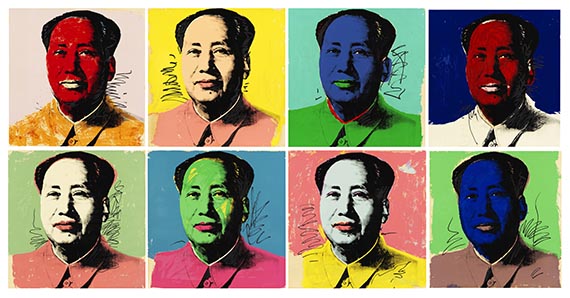
Mao, 1972.
Series of 10 Silkscreen in colors
Estimation:
€ 100,000 / $ 116,000 Résultat:
€ 129,000 / $ 149,640 ( frais d'adjudication compris)
132
Andy Warhol
Mao, 1972.
Series of 10 Silkscreen in colors
Estimation:
€ 100,000 / $ 116,000 Résultat:
€ 129,000 / $ 149,640 ( frais d'adjudication compris)
Andy Warhol
1928 - 1987
Mao. 1972.
Series of 10 Silkscreen in colors.
Each frame bears the publisher's handwritten name on the back panel, as well as with a typographically inscribed label. Trial proo before the edition of 250 copies. On firm, smooth Beckett High White paper. Each ca. 91.4 x 91.4 cm (35.9 x 35.9 in), size of sheet.
The final edition was printed by Styria Studio, Inc., New York, and published by Castelli Graphics and Multiples, Inc., New York
Two motifs are included twice (Feldman/Schellmann/Defendi II.97 and II.99). However, Feldman/Schellmann/Defendi II.92 and II.94 are not included. [JS].
• Extremely rare: Trial proofs for Warhol's famous “Mao” set.
• Art Basel 1972: Presented by Marian Goodman's famous graphic arts publisher Multiple Inc., New York, to promote the “Mao” set, which was due to be released in November.
• Excellent provenance: Acquired directly from Marian Goodman in Basel in 1972 in exchange for another work, since then part of an important German private collection.
• Outstanding print quality: Opaque, glossy ink application in bright and rich colors.
PROVENANCE: Multiples, Inc., New York (Marian Goodman's publishing house and publisher of the portfolio; each frame backing bears handwritten labels as well as a label with a crossed-out ownership note)
Private collection, Berlin (formerly art dealer; acquired at Art Basel in 1972 in exchange from the aforementioned; in the family's possession ever since).
EXHIBITION: Art Basel, 1972 (presented by Multiples Inc, New York).
"In 1972 and 1973, Warhol produced five series of paintings, a portfolio of prints, and a series of drawings, all based on the same image of Mao Zedong. In Holy Terror, his biography of Warhol, Bob Colacello relates how the Mao paintings came to be made: > [..] Bruno`s [Bischofberger] idea was that Andy should paint the most important figure of the tewenteeth century.< [..] He proposed Albert Einstein, who, in Colacello`s words, >was responsible for both the technological richness and the technological terror of life in this century.< >`Oh,`said Andy. That's a good idea. But I was just reading in Life magazine that the most famous person in the world today is Chairman Mao. Shouldn't it be the the most famous person<"
The Andy Warhol Foundation, Catalogue Raisonne, vol. 3, p. 165.
1928 - 1987
Mao. 1972.
Series of 10 Silkscreen in colors.
Each frame bears the publisher's handwritten name on the back panel, as well as with a typographically inscribed label. Trial proo before the edition of 250 copies. On firm, smooth Beckett High White paper. Each ca. 91.4 x 91.4 cm (35.9 x 35.9 in), size of sheet.
The final edition was printed by Styria Studio, Inc., New York, and published by Castelli Graphics and Multiples, Inc., New York
Two motifs are included twice (Feldman/Schellmann/Defendi II.97 and II.99). However, Feldman/Schellmann/Defendi II.92 and II.94 are not included. [JS].
• Extremely rare: Trial proofs for Warhol's famous “Mao” set.
• Art Basel 1972: Presented by Marian Goodman's famous graphic arts publisher Multiple Inc., New York, to promote the “Mao” set, which was due to be released in November.
• Excellent provenance: Acquired directly from Marian Goodman in Basel in 1972 in exchange for another work, since then part of an important German private collection.
• Outstanding print quality: Opaque, glossy ink application in bright and rich colors.
PROVENANCE: Multiples, Inc., New York (Marian Goodman's publishing house and publisher of the portfolio; each frame backing bears handwritten labels as well as a label with a crossed-out ownership note)
Private collection, Berlin (formerly art dealer; acquired at Art Basel in 1972 in exchange from the aforementioned; in the family's possession ever since).
EXHIBITION: Art Basel, 1972 (presented by Multiples Inc, New York).
"In 1972 and 1973, Warhol produced five series of paintings, a portfolio of prints, and a series of drawings, all based on the same image of Mao Zedong. In Holy Terror, his biography of Warhol, Bob Colacello relates how the Mao paintings came to be made: > [..] Bruno`s [Bischofberger] idea was that Andy should paint the most important figure of the tewenteeth century.< [..] He proposed Albert Einstein, who, in Colacello`s words, >was responsible for both the technological richness and the technological terror of life in this century.< >`Oh,`said Andy. That's a good idea. But I was just reading in Life magazine that the most famous person in the world today is Chairman Mao. Shouldn't it be the the most famous person<"
The Andy Warhol Foundation, Catalogue Raisonne, vol. 3, p. 165.
Marilyn, Jackie, the Queen, and Mao—Warhol’s principle of serial reproduction as the epitome of Pop Art
Warhol’s ability to sift through the deluge of images in mass media to find those with the unique ability and depth to capture a pivotal moment in contemporary history is truly singular. Accordingly, Warhol created timeless pop art icons with his legendary portraits of Marilyn, Jackie, Elvis, Mick Jagger, and the Queen, as well as with his famous Mao portfolio, in which the New York artist staged the Communist dictator and mass media figure Mao Zedong in a series of images that are just as striking and colorful as his depictions of Hollywood star Marilyn Monroe. Naturally, Mao, the Communist leader and founder of the People’s Republic of China, printed in a series of bright color variations, takes his place among Warhol’s famous “Campbell’s Soup” cans and dollar signs. In a bold and provocative move, Mao is presented in vibrant color silkscreen prints alongside mass-produced icons of American consumerism, within that very grey area between art and commerce that Warhol so masterfully explored. Since the 1960s, the nonconformist Warhol dared to take the significant step of a radical fresh start in art in New York, leaving behind all traditional notions of art and the role of the artist with confidence and courage: Warhol fascinatingly merged art and commerce, bringing to life everything the philosopher and art critic Walter Benjamin had envisioned in the first half of the 20th century as a terrifying apocalyptic scenario for art. Provocative, confident, and subtle, Warhol plays with originality and aura, hitherto the key qualities of art, which he skillfully questions and puts to the test through his serial works. It is precisely his legendary serial silkscreen prints “Marilyn Monroe” and “Mao”—motifs with which Warhol captured contemporary history and was to make art history—that are celebrated today as icons of American Pop Art, and they are surrounded—seemingly paradoxically—by a very special aura.
Warhol’s “Mao”: From dictator to pop star – art, commerce, and communism
Andy Warhol was forty-three years old and working at his famous New York “Factory” at 33 West Union Square—the second “Factory” location, which he set up in 1968—when he used the official portrait of the communist leader and founder of the People’s Republic of China for his iconic silk-screen series. In 1972, the year Warhol’s portfolio was created, the official portrait of Mao Zedong was the most reproduced portrait in the world. Twenty-three years after the People’s Republic of China had been founded, Mao had evolved from a politician and communist leader into a global media superstar, who, with his enormous mass-media presence, even surpassed the celebrity cult of a Marilyn Monroe in Hollywood. The catalyst for Warhol’s series in 1972 was U. S. President Richard Nixon’s trip to China, which once again highlighted Mao’s omnipresence in the media. Warhol, who was in constant search of photos with his Polaroid Big Shot camera, was an exceptionally sharp observer and chronicler of his time. He was captivated not only by the mass circulation of Mao's face in China, but also by a previously unknown global reach. Mao, whose person cult triggered a deluge of images that increasingly stylized him as a political symbol, was artistically transformed into a capitalist consumer object and, as such, elevated to the same level as Marilyn Monroe. Warhol also made significant technical strides in the Mao series’s outstanding color silkscreen prints compared to his early portfolios. His “Maos” captivate with their dynamic, painterly-spontaneous style, the clearly visible, at times wild brushstrokes, the line structures that appear as if spontaneously applied with a black felt-tip pen onto the colored surfaces, and their rich, luminous coloring.
Art Basel 1972: Marian Goodman presented the first proofs of the famous “Mao” portfolio
In the summer of 1972, the first proofs of this portfolio were produced in New York; it was officially released in November 1972 in an edition of 250 copies, in collaboration with the two legendary New York art publishers, Castelli Graphics and Multiple Inc., with the option to place advance orders. Marian Goodman’s renowned graphic arts publishing company, Multiple Inc., New York, presented the first proofs of the “Maos” at Art Basel in June 1972. The official release was scheduled for the fall of 1972. At Art Basel, the first buyers were able to place orders for Warhol’s revolutionary series, which was then exhibited for the first time at the Kunstmuseum Basel in the exhibition “Andy Warhol: Mao – Zehn Bildnisse von Mao Tse-tung” (October 21–November 19, 1972), marking its second global appearance, also in Switzerland. These prints were likely the very first, particularly early prints of this motif, which preceded the limited edition of 250 copies by several months and were presented by Marian Goodman at Art Basel in 1972 as part of the official preview of the portfolio. Marian Goodman ultimately exchanged these proof prints in Basel with a prominent German art publisher for works from his current publishing portfolio. Consequently, these unique and art-historically significant proof prints were not to return to New York after the end of Art Basel, but have remained in the outstanding collection of the prominent German art publisher to this day. More than fifty-five years later, these remarkable early prints are now on public display as part of our Evening Sale again. [JS]
Warhol’s ability to sift through the deluge of images in mass media to find those with the unique ability and depth to capture a pivotal moment in contemporary history is truly singular. Accordingly, Warhol created timeless pop art icons with his legendary portraits of Marilyn, Jackie, Elvis, Mick Jagger, and the Queen, as well as with his famous Mao portfolio, in which the New York artist staged the Communist dictator and mass media figure Mao Zedong in a series of images that are just as striking and colorful as his depictions of Hollywood star Marilyn Monroe. Naturally, Mao, the Communist leader and founder of the People’s Republic of China, printed in a series of bright color variations, takes his place among Warhol’s famous “Campbell’s Soup” cans and dollar signs. In a bold and provocative move, Mao is presented in vibrant color silkscreen prints alongside mass-produced icons of American consumerism, within that very grey area between art and commerce that Warhol so masterfully explored. Since the 1960s, the nonconformist Warhol dared to take the significant step of a radical fresh start in art in New York, leaving behind all traditional notions of art and the role of the artist with confidence and courage: Warhol fascinatingly merged art and commerce, bringing to life everything the philosopher and art critic Walter Benjamin had envisioned in the first half of the 20th century as a terrifying apocalyptic scenario for art. Provocative, confident, and subtle, Warhol plays with originality and aura, hitherto the key qualities of art, which he skillfully questions and puts to the test through his serial works. It is precisely his legendary serial silkscreen prints “Marilyn Monroe” and “Mao”—motifs with which Warhol captured contemporary history and was to make art history—that are celebrated today as icons of American Pop Art, and they are surrounded—seemingly paradoxically—by a very special aura.
Warhol’s “Mao”: From dictator to pop star – art, commerce, and communism
Andy Warhol was forty-three years old and working at his famous New York “Factory” at 33 West Union Square—the second “Factory” location, which he set up in 1968—when he used the official portrait of the communist leader and founder of the People’s Republic of China for his iconic silk-screen series. In 1972, the year Warhol’s portfolio was created, the official portrait of Mao Zedong was the most reproduced portrait in the world. Twenty-three years after the People’s Republic of China had been founded, Mao had evolved from a politician and communist leader into a global media superstar, who, with his enormous mass-media presence, even surpassed the celebrity cult of a Marilyn Monroe in Hollywood. The catalyst for Warhol’s series in 1972 was U. S. President Richard Nixon’s trip to China, which once again highlighted Mao’s omnipresence in the media. Warhol, who was in constant search of photos with his Polaroid Big Shot camera, was an exceptionally sharp observer and chronicler of his time. He was captivated not only by the mass circulation of Mao's face in China, but also by a previously unknown global reach. Mao, whose person cult triggered a deluge of images that increasingly stylized him as a political symbol, was artistically transformed into a capitalist consumer object and, as such, elevated to the same level as Marilyn Monroe. Warhol also made significant technical strides in the Mao series’s outstanding color silkscreen prints compared to his early portfolios. His “Maos” captivate with their dynamic, painterly-spontaneous style, the clearly visible, at times wild brushstrokes, the line structures that appear as if spontaneously applied with a black felt-tip pen onto the colored surfaces, and their rich, luminous coloring.
Art Basel 1972: Marian Goodman presented the first proofs of the famous “Mao” portfolio
In the summer of 1972, the first proofs of this portfolio were produced in New York; it was officially released in November 1972 in an edition of 250 copies, in collaboration with the two legendary New York art publishers, Castelli Graphics and Multiple Inc., with the option to place advance orders. Marian Goodman’s renowned graphic arts publishing company, Multiple Inc., New York, presented the first proofs of the “Maos” at Art Basel in June 1972. The official release was scheduled for the fall of 1972. At Art Basel, the first buyers were able to place orders for Warhol’s revolutionary series, which was then exhibited for the first time at the Kunstmuseum Basel in the exhibition “Andy Warhol: Mao – Zehn Bildnisse von Mao Tse-tung” (October 21–November 19, 1972), marking its second global appearance, also in Switzerland. These prints were likely the very first, particularly early prints of this motif, which preceded the limited edition of 250 copies by several months and were presented by Marian Goodman at Art Basel in 1972 as part of the official preview of the portfolio. Marian Goodman ultimately exchanged these proof prints in Basel with a prominent German art publisher for works from his current publishing portfolio. Consequently, these unique and art-historically significant proof prints were not to return to New York after the end of Art Basel, but have remained in the outstanding collection of the prominent German art publisher to this day. More than fifty-five years later, these remarkable early prints are now on public display as part of our Evening Sale again. [JS]