


Image du cadre
Autre image
Autre image
Autre image
Autre image
Autre image
Autre image
Autre image
Autre image
Autre image
Autre image
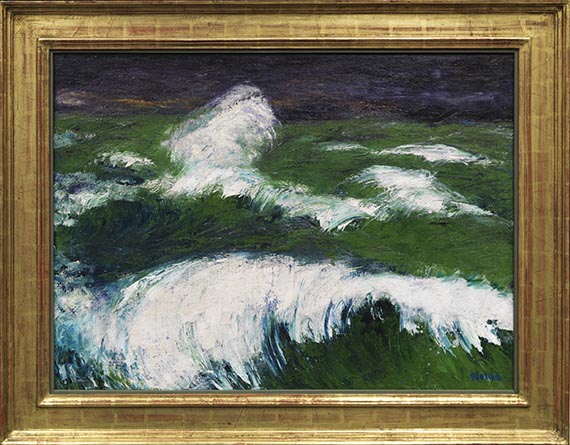
30
Emil Nolde
Meer (D), 1930.
Oil on canvas
Estimation: € 800,000 / $ 936,000
30
Emil Nolde
Meer (D), 1930.
Oil on canvas
Estimation: € 800,000 / $ 936,000
Emil Nolde
1867 - 1956
Meer (D). 1930.
Oil on canvas.
Signed in the lower right. Signed and titled on the stretcher. 74.5 x 100.5 cm (29.3 x 39.5 in).
• The sea as a primal force is one of the key themes of Nolde's creation.
• Nolde puts the observer right into the sea to make its elemental force perceptible.
• In this almost non-representational depiction of the sea, color is the defining element.
• Two of the six seascapes made on Sylt in 1930 are considered lost.
• "Meer (B)" from this series of seascapes is in possession of Tate Modern, London.
• Part of the traveling exhibition "Neuere deutsche Kunst", the most important exhibition project of Modern Art at the end of the Weimar Republic.
PROVENANCE: Wilhelm Ritzerfeld Collection, Berlin (around 1935).
Elvira Ritzerfeld, Berlin (obtained from teh above, until 1966: Sotheby’s, June 22, 1966).
M. Knoedler & Co., New York (with the label on the reverse).
Roman Norbert Ketterer, Campione d'Italia (1968/69).
Collection Udo Bey, Soregno/ Switzerland (1990).
Private collection, Northern Germany
Private collection, Switzerland.
EXHIBITION: Kunsthütte Chemnitz, presumably: Der deutsche Norden (Barlach, Nolde, Rohlfs), January/February 1932 (with the stamped label on the reverse).
Traveling exhibition "Neuere Deutsche Kunst“, May 1932-July 1932 (Copenhagen, Den Frie udstilling, May 1932, no. 158; Cologne, Großer Kongress-Saal der Kölner Messe, June-July 1932, no. 147)
Expressionismus, Spencer A. Samuels, New York, 1968, no. 11 (illustrated).
LITERATURE: Martin Urban, Emil Nolde. Werkverzeichnis der Gemälde, vol. II (1915-1951), Munich 1990, CR no. 1103 (illustrated)
-
Artist's handlist (1930).
Sotheby and Co., London, Catalogue of impressionist and modern paintings, drawings and sculpture, June 22, 1966, lot 86.
Wenzel Nachbaur, Moderne Kunst V. Inventory catalog Roman Norbert Ketterer,
Campione d’Italia 1968, no. 125.
Wenzel Nachbaur, Moderne Kunst VI. Inventory catalog Roman Norbert Ketterer,
Campione d’Italia 1969, no. 88.
Naima Salam, Marokkanische und europäische Kunsttraditionen als Inspirationsquelle für die marokkanische Malerei der Gegenwart Münster 2004, p. 198 note 564.
Markus Lörz, Neuere Deutsche Kunst: Oslo, Copenhagen, Cologne 1932. Rekonstruktion und Dokumentation, Stuttgart 2008, addendum p. 17
Nina Hinrichs, Wattenmeer und Nordsee in der Kunst. Darstellungen von Nolde bis Beckmann, 2019, p. 599 (illustrated).
"I painted what showed in front of my papers and canvasses: the clouds, the waves, the dunes and then my passionate sea pictures with crashing waves and spray [..] I had six sea pictures, paint still wet, almost completed, still ecstatically working on them, looking at them again and again."
Emil Nolde about his stay on Sylt in 1930, quoted from: Reisen, Ächtung, Befreiung: 1919-1946, Cologne 1978, pp. 104/ 105.
"Nolde painted the sea as an elemental being and as an apotheosis of light and infinity. [..] Complete immersion in the elemental force of nature to a dangerous point, becoming one with the goal of grasping things and being seized by them, in order to then paint the picture from memory, far from the surface world, following only the power of imagination and the colors’ sensuous lure - no subject suited the painter more. He could let the colors flow in complete freedom, in order to direct them into compositional order." (Martin Urban, Emil Nolde. Landschaften. Aquarelle und Zeichnungen, Cologne 2002, p. 32).
Called up: ca. 17.58 h +/- 20 min.
1867 - 1956
Meer (D). 1930.
Oil on canvas.
Signed in the lower right. Signed and titled on the stretcher. 74.5 x 100.5 cm (29.3 x 39.5 in).
• The sea as a primal force is one of the key themes of Nolde's creation.
• Nolde puts the observer right into the sea to make its elemental force perceptible.
• In this almost non-representational depiction of the sea, color is the defining element.
• Two of the six seascapes made on Sylt in 1930 are considered lost.
• "Meer (B)" from this series of seascapes is in possession of Tate Modern, London.
• Part of the traveling exhibition "Neuere deutsche Kunst", the most important exhibition project of Modern Art at the end of the Weimar Republic.
PROVENANCE: Wilhelm Ritzerfeld Collection, Berlin (around 1935).
Elvira Ritzerfeld, Berlin (obtained from teh above, until 1966: Sotheby’s, June 22, 1966).
M. Knoedler & Co., New York (with the label on the reverse).
Roman Norbert Ketterer, Campione d'Italia (1968/69).
Collection Udo Bey, Soregno/ Switzerland (1990).
Private collection, Northern Germany
Private collection, Switzerland.
EXHIBITION: Kunsthütte Chemnitz, presumably: Der deutsche Norden (Barlach, Nolde, Rohlfs), January/February 1932 (with the stamped label on the reverse).
Traveling exhibition "Neuere Deutsche Kunst“, May 1932-July 1932 (Copenhagen, Den Frie udstilling, May 1932, no. 158; Cologne, Großer Kongress-Saal der Kölner Messe, June-July 1932, no. 147)
Expressionismus, Spencer A. Samuels, New York, 1968, no. 11 (illustrated).
LITERATURE: Martin Urban, Emil Nolde. Werkverzeichnis der Gemälde, vol. II (1915-1951), Munich 1990, CR no. 1103 (illustrated)
-
Artist's handlist (1930).
Sotheby and Co., London, Catalogue of impressionist and modern paintings, drawings and sculpture, June 22, 1966, lot 86.
Wenzel Nachbaur, Moderne Kunst V. Inventory catalog Roman Norbert Ketterer,
Campione d’Italia 1968, no. 125.
Wenzel Nachbaur, Moderne Kunst VI. Inventory catalog Roman Norbert Ketterer,
Campione d’Italia 1969, no. 88.
Naima Salam, Marokkanische und europäische Kunsttraditionen als Inspirationsquelle für die marokkanische Malerei der Gegenwart Münster 2004, p. 198 note 564.
Markus Lörz, Neuere Deutsche Kunst: Oslo, Copenhagen, Cologne 1932. Rekonstruktion und Dokumentation, Stuttgart 2008, addendum p. 17
Nina Hinrichs, Wattenmeer und Nordsee in der Kunst. Darstellungen von Nolde bis Beckmann, 2019, p. 599 (illustrated).
"I painted what showed in front of my papers and canvasses: the clouds, the waves, the dunes and then my passionate sea pictures with crashing waves and spray [..] I had six sea pictures, paint still wet, almost completed, still ecstatically working on them, looking at them again and again."
Emil Nolde about his stay on Sylt in 1930, quoted from: Reisen, Ächtung, Befreiung: 1919-1946, Cologne 1978, pp. 104/ 105.
"Nolde painted the sea as an elemental being and as an apotheosis of light and infinity. [..] Complete immersion in the elemental force of nature to a dangerous point, becoming one with the goal of grasping things and being seized by them, in order to then paint the picture from memory, far from the surface world, following only the power of imagination and the colors’ sensuous lure - no subject suited the painter more. He could let the colors flow in complete freedom, in order to direct them into compositional order." (Martin Urban, Emil Nolde. Landschaften. Aquarelle und Zeichnungen, Cologne 2002, p. 32).
Called up: ca. 17.58 h +/- 20 min.
Delving into nature: Nolde’s artistic exploration of nature
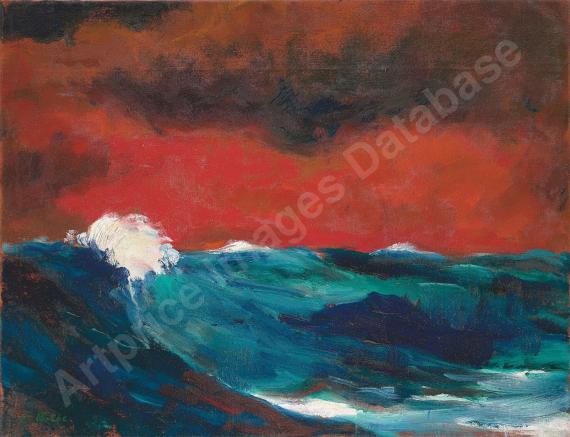
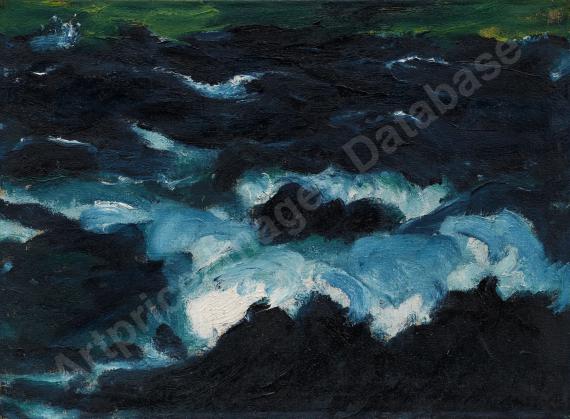
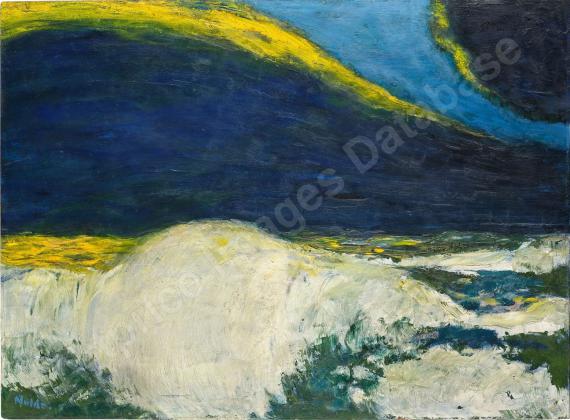
Throughout his entire creative activity, the sea always played an important role in Nolde’s art. He made the “Herbstmeere” (Autumn Seas) as early as 1910/11, a series of 20 paintings. "Nolde painted the sea as an elemental being and as an apotheosis of light and infinity. [.] Complete immersion in the elemental force of nature to a dangerous point, becoming one to grasp the things fully and being seized by them, to then paint the picture from memory, far from the surface world, following only the imagination and the sensuous lure of the colors - no theme suited the painter more. Here he was able to give the flow of colors complete freedom, at the same time confidently guiding them into a compositional order", says Martin Urban, art historian and long-time director of the Ada and Emil Nolde Foundation in Seebüll (quoted from: Martin Urban, Emil Nolde. Landschaften. Aquarelle und Zeichnungen, Cologne 2002, p. 32).
Between Ecstasy and Melancholy - An expressive creative frenzy on Sylt
This picture is part of a series of six seascapes that he painted in quick succession during a stay on the North German island of Sylt in the fall of 1930. Months had passed, and most people had left. It all happened very quickly. I was almost alone. Autumn had come, and the days were short. Thunderclouds brought along hailstorms - lightning flashed into the sea. My thoughts were dull, my happy cheerfulness is over, as it often happens in a tormenting way, like in the autumn of life. I made six sea pictures, the paint still wet, almost finished, worked ecstatically, examining them over and over again." Nolde described the intense time of the creation of these seascapes (Emil Nolde, Mein Leben. Am Westmeer 1930, Cologne 1993, p. 378). Nolde's characteristically expressive brushwork and the intensive use of color allow the observer to feel the sea’s surging turmoil. He must have felt like the French realist Gustave Courbet, when he captured the powerful, surging waves with foamy spray in Étretat on the French Atlantic coast, in many different variations around 60 years earlier. Courbet and Nolde were equally fascinated by the endlessly recurring spectacle of crashing waves and stormy weather, with wind-blown spray. The roar of the sea resonates in the impulsiveness of Nolde's painting: an expressive depiction of nature guided by emotion, with the autumnal light reflected on the crests of crashing waves. In this work, Nolde's interpretation of sea and sky is guided by his own sensation. Nolde transfers what he sees into a landscape painting in which realism serves only to provide orientation. At the same time, the expressive use of color permeates the motif, making it sensually perceptible. The typical dark gray-blue of the turbulent waters of the North Sea is heightened with shades of green and turquoise; the dark violet-tinted sky on the far horizon underscores the tense, melancholic evening atmosphere of the autumn day coming to its end. Nolde dispenses with the stage of solid ground, like a beach or the like; he places himself and the viewer in the midst of the effervescent spray and lets his excitement run free with this gesture.
"The wind was heartily fresh and invigorating, and I enjoyed walking on the hard sand along the sea", rhapsodized Nolde about his stay on the "Westmeer" (West Sea). "The waves, their growl, the clouds in front of and above me, the beach, the dunes, the gray grass, it was all mine. […] I could hardly endure what was so pretty and free, healthy and glorious to everyone else. I ran along the beach or through the liquid sand of the dunes for hours, like a drunk [..] I hardly understood it all and accepted it, moved calmly, as calm as my colors were, whether I was painting the grey-green dunes, the raging sea, or the people." (Emil Nolde, Mein Leben. Am Westmeer 1930, Cologne 1993, p. 377) Nolde was on his own on Sylt, while his wife, Ada, oversaw the expansion of the property in Seebüll, which he had acquired in 1927. Nolde arrived on the island in late August 1930 and stayed for two months. He found accommodation at "Haus Kliffende" in Kampen.
Solitude and a burst of color: Autumn on Sylt between Courbet and Cézanne
The holiday season ended in September, and the island grew emptier. Nolde decided to stay until the end of October, moving into the log cabin of his landlady, Clara Tiedemann. "The dunes and beaches are deserted now, and the waves have washed away the last traces of the people from the city", wrote Nolde to his wife Ada (quoted from: Elke Backert, Malerischer Abschied vom Sommer: Emil Nolde auf Sylt, in: Frankfurt Live, August 22, 2016). It was only in October that nature provided an atmosphere that stimulated the artist to make paintings like this "Meer," with its surging water, gloomy, turbulent, and threatening. "Everything has been dull for weeks now, and I walk and walk on the beach or in the dunes, maybe a little tired and having a hard time bearing the loneliness", Nolde reported to Ada in Seebüll (ibid.). And Nolde, looking at the sea with his feeling of loneliness, may have recalled "La Vague" by Gustave Courbet, the painted wave that has been in the Nationalgalerie in Berlin since 1906 and about which Paul Cézanne wrote enthusiastically: ".. the [wave] in Berlin is wonderful, one of the miracles of the century, much more agile, much more tense, with a more poisonous green, with a dirtier orange than this one [at Musée Louvre], with the frothy spray of the flood coming from the depths of eternity, the sky in tatters and the pale sharpness. It's as if it came right at you; you step back. The whole hall smells of spray" (quoted from: Joachim Gasquet, Cézanne, Berlin 1930, p. 141). "It was as if the open air, the salty taste, the roaring waves spurred me and made me happy", says Nolde, delighted about his intensive and fruitful encounter with the "West Sea" on the island of Sylt.
Throughout his entire creative activity, the sea always played an important role in Nolde’s art. He made the “Herbstmeere” (Autumn Seas) as early as 1910/11, a series of 20 paintings. "Nolde painted the sea as an elemental being and as an apotheosis of light and infinity. [.] Complete immersion in the elemental force of nature to a dangerous point, becoming one to grasp the things fully and being seized by them, to then paint the picture from memory, far from the surface world, following only the imagination and the sensuous lure of the colors - no theme suited the painter more. Here he was able to give the flow of colors complete freedom, at the same time confidently guiding them into a compositional order", says Martin Urban, art historian and long-time director of the Ada and Emil Nolde Foundation in Seebüll (quoted from: Martin Urban, Emil Nolde. Landschaften. Aquarelle und Zeichnungen, Cologne 2002, p. 32).
Between Ecstasy and Melancholy - An expressive creative frenzy on Sylt
This picture is part of a series of six seascapes that he painted in quick succession during a stay on the North German island of Sylt in the fall of 1930. Months had passed, and most people had left. It all happened very quickly. I was almost alone. Autumn had come, and the days were short. Thunderclouds brought along hailstorms - lightning flashed into the sea. My thoughts were dull, my happy cheerfulness is over, as it often happens in a tormenting way, like in the autumn of life. I made six sea pictures, the paint still wet, almost finished, worked ecstatically, examining them over and over again." Nolde described the intense time of the creation of these seascapes (Emil Nolde, Mein Leben. Am Westmeer 1930, Cologne 1993, p. 378). Nolde's characteristically expressive brushwork and the intensive use of color allow the observer to feel the sea’s surging turmoil. He must have felt like the French realist Gustave Courbet, when he captured the powerful, surging waves with foamy spray in Étretat on the French Atlantic coast, in many different variations around 60 years earlier. Courbet and Nolde were equally fascinated by the endlessly recurring spectacle of crashing waves and stormy weather, with wind-blown spray. The roar of the sea resonates in the impulsiveness of Nolde's painting: an expressive depiction of nature guided by emotion, with the autumnal light reflected on the crests of crashing waves. In this work, Nolde's interpretation of sea and sky is guided by his own sensation. Nolde transfers what he sees into a landscape painting in which realism serves only to provide orientation. At the same time, the expressive use of color permeates the motif, making it sensually perceptible. The typical dark gray-blue of the turbulent waters of the North Sea is heightened with shades of green and turquoise; the dark violet-tinted sky on the far horizon underscores the tense, melancholic evening atmosphere of the autumn day coming to its end. Nolde dispenses with the stage of solid ground, like a beach or the like; he places himself and the viewer in the midst of the effervescent spray and lets his excitement run free with this gesture.
"The wind was heartily fresh and invigorating, and I enjoyed walking on the hard sand along the sea", rhapsodized Nolde about his stay on the "Westmeer" (West Sea). "The waves, their growl, the clouds in front of and above me, the beach, the dunes, the gray grass, it was all mine. […] I could hardly endure what was so pretty and free, healthy and glorious to everyone else. I ran along the beach or through the liquid sand of the dunes for hours, like a drunk [..] I hardly understood it all and accepted it, moved calmly, as calm as my colors were, whether I was painting the grey-green dunes, the raging sea, or the people." (Emil Nolde, Mein Leben. Am Westmeer 1930, Cologne 1993, p. 377) Nolde was on his own on Sylt, while his wife, Ada, oversaw the expansion of the property in Seebüll, which he had acquired in 1927. Nolde arrived on the island in late August 1930 and stayed for two months. He found accommodation at "Haus Kliffende" in Kampen.
Solitude and a burst of color: Autumn on Sylt between Courbet and Cézanne
The holiday season ended in September, and the island grew emptier. Nolde decided to stay until the end of October, moving into the log cabin of his landlady, Clara Tiedemann. "The dunes and beaches are deserted now, and the waves have washed away the last traces of the people from the city", wrote Nolde to his wife Ada (quoted from: Elke Backert, Malerischer Abschied vom Sommer: Emil Nolde auf Sylt, in: Frankfurt Live, August 22, 2016). It was only in October that nature provided an atmosphere that stimulated the artist to make paintings like this "Meer," with its surging water, gloomy, turbulent, and threatening. "Everything has been dull for weeks now, and I walk and walk on the beach or in the dunes, maybe a little tired and having a hard time bearing the loneliness", Nolde reported to Ada in Seebüll (ibid.). And Nolde, looking at the sea with his feeling of loneliness, may have recalled "La Vague" by Gustave Courbet, the painted wave that has been in the Nationalgalerie in Berlin since 1906 and about which Paul Cézanne wrote enthusiastically: ".. the [wave] in Berlin is wonderful, one of the miracles of the century, much more agile, much more tense, with a more poisonous green, with a dirtier orange than this one [at Musée Louvre], with the frothy spray of the flood coming from the depths of eternity, the sky in tatters and the pale sharpness. It's as if it came right at you; you step back. The whole hall smells of spray" (quoted from: Joachim Gasquet, Cézanne, Berlin 1930, p. 141). "It was as if the open air, the salty taste, the roaring waves spurred me and made me happy", says Nolde, delighted about his intensive and fruitful encounter with the "West Sea" on the island of Sylt.
Commission, taxes et droit de suite
Cet objet est offert avec imposition régulière.
Calcul en cas d'imposition régulière:
Prix d’adjudication jusqu’à 1 000 000 euros : frais de vente 29%.
Des frais de vente de 23% sont facturés sur la partie du prix d’adjudication dépassant 1 000 000 euros. Ils sont additionnés aux frais de vente dus pour la partie du prix d’adjudication allant jusqu’à 1 000 000 euros.
Des frais de vente de 15 % sont facturés sur la partie du prix d’adjudication dépassant 4 000 000 euros. Ils sont additionnés aux frais de vente dus pour la partie du prix d’adjudication allant jusqu’à 4 000 000 euros.
La taxe sur la valeur ajoutée allemande, actuellement de 7 %, est perçue sur la somme du prix d’adjudication et des frais de vente.
Pour les entreprises habilitées à déduire la TVA, le régime fiscal général peut être appliqué.
Calcul en cas de droit de suite:
Pour les œuvres originales d’arts plastiques et de photographie d’artistes vivants ou d’artistes décédés il y a moins de 70 ans, soumises au droit de suite, une rémunération au titre du droit de suite à hauteur des pourcentages indiqués au § 26, al. 2 de la loi allemande sur les droits d’auteur (UrhG) est facturée en sus pour compenser la rémunération liée au droit de suite due par le commissaire-priseur conformément au § 26 UrhG. À ce jour, elle est calculée comme suit :
4 pour cent pour la part du produit de la vente à partir de 400,00 euros et jusqu’à 50 000 euros,
3 pour cent supplémentaires pour la part du produit de la vente entre 50 000,01 et 200 000 euros,
1 pour cent supplémentaire pour la part entre 200 000,01 et 350 000 euros,
0,5 pour cent supplémentaire pour la part entre 350 000,01 et 500 000 euros et
0,25 pour cent supplémentaire pour la part au-delà de 500 000 euros.
Le total de la rémunération au titre du droit de suite pour une revente s’élève au maximum à 12 500 euros.
Calcul en cas d'imposition régulière:
Prix d’adjudication jusqu’à 1 000 000 euros : frais de vente 29%.
Des frais de vente de 23% sont facturés sur la partie du prix d’adjudication dépassant 1 000 000 euros. Ils sont additionnés aux frais de vente dus pour la partie du prix d’adjudication allant jusqu’à 1 000 000 euros.
Des frais de vente de 15 % sont facturés sur la partie du prix d’adjudication dépassant 4 000 000 euros. Ils sont additionnés aux frais de vente dus pour la partie du prix d’adjudication allant jusqu’à 4 000 000 euros.
La taxe sur la valeur ajoutée allemande, actuellement de 7 %, est perçue sur la somme du prix d’adjudication et des frais de vente.
Pour les entreprises habilitées à déduire la TVA, le régime fiscal général peut être appliqué.
Calcul en cas de droit de suite:
Pour les œuvres originales d’arts plastiques et de photographie d’artistes vivants ou d’artistes décédés il y a moins de 70 ans, soumises au droit de suite, une rémunération au titre du droit de suite à hauteur des pourcentages indiqués au § 26, al. 2 de la loi allemande sur les droits d’auteur (UrhG) est facturée en sus pour compenser la rémunération liée au droit de suite due par le commissaire-priseur conformément au § 26 UrhG. À ce jour, elle est calculée comme suit :
4 pour cent pour la part du produit de la vente à partir de 400,00 euros et jusqu’à 50 000 euros,
3 pour cent supplémentaires pour la part du produit de la vente entre 50 000,01 et 200 000 euros,
1 pour cent supplémentaire pour la part entre 200 000,01 et 350 000 euros,
0,5 pour cent supplémentaire pour la part entre 350 000,01 et 500 000 euros et
0,25 pour cent supplémentaire pour la part au-delà de 500 000 euros.
Le total de la rémunération au titre du droit de suite pour une revente s’élève au maximum à 12 500 euros.